


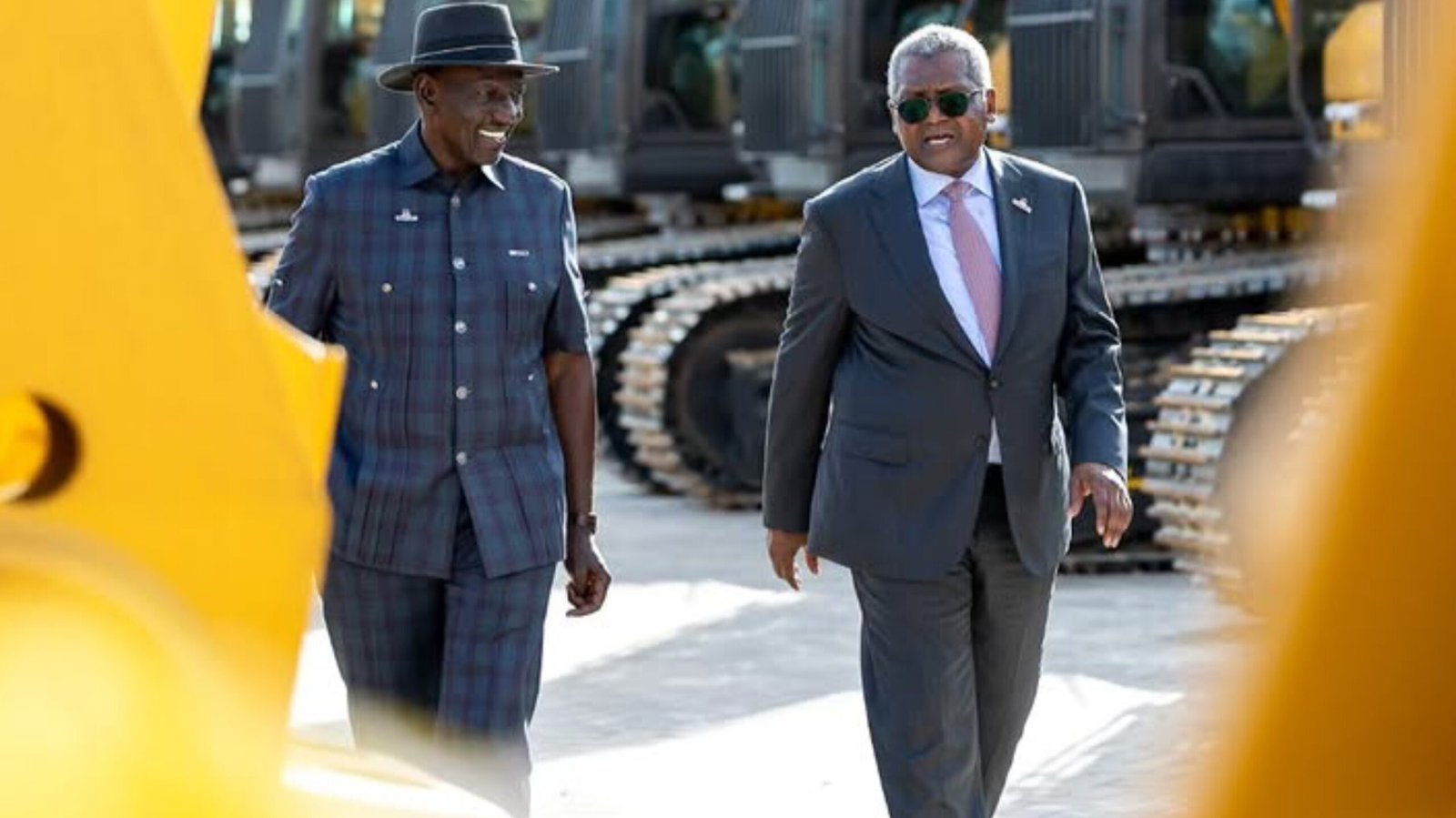
The KSh2.2 trillion project is less about Kenya’s oil and more about turning Lamu into a major fuel and industrial gateway for East Africa.
Kenya is about to get one of Africa’s biggest oil refineries.
There is just one obvious question: where will all the oil come from?
The Dangote East Africa Petroleum Refinery in Lamu is designed to process up to 700,000 barrels of crude oil every day. The project, valued at about KSh2.2 trillion ($16 billion), officially broke ground on September 30, 2026.
But Kenya does not produce anything close to 700,000 barrels a day.
Kenya’s South Lokichar oil fields in Turkana are expected to eventually produce around 50,000 barrels a day.
At that level, Kenyan crude would supply only about 7% of the refinery’s full capacity.
So why build it in Kenya?
The answer has less to do with how much oil Kenya has and more to do with where Kenya is.
Dangote is betting on Lamu’s location
Lamu sits on the Indian Ocean and is at the centre of the massive LAPSSET corridor, which is intended to connect Kenya’s coast with northern Kenya and landlocked markets such as Ethiopia and South Sudan.
That changes the calculation.
Dangote does not have to depend entirely on Kenyan crude.
President William Ruto has confirmed that Kenya is discussing a pipeline linking Turkana to Lamu, allowing locally produced crude to reach the refinery.
But Kenyan oil alone will not be enough.
Crude will have to come from other regional and international sources.
That means the refinery is being built with a much bigger market in mind.
Kenya’s oil is only part of the plan
A 700,000-barrel refinery would need enormous quantities of crude every day.
Kenya’s own production could provide only a fraction of that.
The rest could be imported by sea or sourced from other African producers, depending on price, availability and the type of crude required.
Lamu is particularly suited to that model because crude can arrive by tanker through the Indian Ocean before being processed at the refinery.
Then comes the bigger opportunity: East Africa
The refinery is not being built simply to supply Kenyan motorists.
The government says it is intended to serve Kenya and wider East African markets.
That matters because the region consumes far more petroleum products than Kenya alone.
The refinery is expected to produce more than 100 million litres of petroleum products a day when operating at full capacity, including petrol, diesel and jet fuel.
Some of that fuel could remain in Kenya.
The rest could move across the region.
And that is where countries such as Ethiopia become important.
Ethiopia has a problem Kenya doesn’t
Ethiopia has a huge population and a growing economy, but it is landlocked.
It needs fuel, but it cannot receive crude directly through its own seaport.
Lamu offers another potential route.
The idea is to bring crude into Lamu, refine it there and move the finished products inland.
The refinery would therefore sit at the beginning of a potential regional supply chain.
South Sudan could also matter
Then there is South Sudan.
It has crude oil but is landlocked.
A future connection through the LAPSSET corridor could potentially give South Sudan another route towards the Indian Ocean.
But this remains a future possibility, not an existing supply chain.
The necessary infrastructure is still being developed.
And that is important because the refinery’s biggest challenge may ultimately be simple:
Keeping it supplied with enough crude.
It is much bigger than a refinery
The project is being developed as an integrated petroleum and petrochemical complex.
Plans include a 1,000MW power plant, as well as facilities for plastics, fertiliser and chemical manufacturing.
The Kenyan government expects the wider project to generate up to 60,000 direct and indirect jobs.
The idea is that once a giant refinery arrives, other businesses will follow.
Transport companies will need to move products.
Warehouses will need to store them.
Engineers and technicians will be needed to service the facilities.
Manufacturers can supply equipment and materials.
Petrochemical companies can use products from the refinery as raw materials.
That is how Dangote wants the refinery to become an industrial hub, rather than simply a place where crude oil is turned into fuel.
And that explains why Lamu
The project makes little sense if you look only at Kenya’s oil reserves.
It makes much more sense if you look at the map.
Lamu has the ocean.
Lamu has a deep-water port.
Lamu sits within the LAPSSET corridor.
And beyond Kenya are millions of potential fuel consumers in landlocked and rapidly growing markets.
That appears to be the real bet.
Dangote is not betting that Kenya will suddenly produce 700,000 barrels of crude every day.
He is betting that East Africa will need the fuel, Lamu will provide the gateway, and the infrastructure connecting the two will eventually catch up.
But there is still one huge question hanging over the KSh2.2 trillion project:
Can Kenya and its regional partners build the crude-supply and transport infrastructure quickly enough to keep a 700,000-barrel-a-day refinery running?
That answer could determine whether Lamu becomes the industrial gateway Dangote and the Kenyan government envision — or whether the refinery’s enormous capacity becomes its biggest challenge.