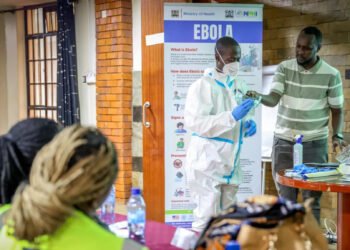



Fresh Ebola fears hit Kiambu after a man was reportedly placed under quarantine over suspected exposure to the deadly virus.
Fresh Ebola fears have reached Kiambu.
A man has reportedly been placed under quarantine in Kiambu after health officials raised concerns that he could have been exposed to Ebola, adding a new layer of anxiety as Kenya races to contain its first confirmed case.
The development comes at a particularly sensitive moment.
Kenya is already tracing people who may have come into contact with the man who became the country’s first confirmed Ebola patient. The government has now accounted for 66 contacts, who are being monitored or quarantined as health teams work to establish whether the virus has spread beyond the original case.
But the Kiambu incident is what is likely to worry Kenyans most.
A suspected case in a heavily populated county, close to Nairobi, immediately raises questions about how quickly the virus could move if another infection is eventually confirmed.
It is important to stress that being quarantined does not mean the man has Ebola. Quarantine is a precaution used while health officials assess someone’s possible exposure and wait for medical investigations.
Kenya is already operating under heightened surveillance after confirming its first imported case of Bundibugyo Ebola virus disease. The patient, a Kenyan who had lived in the Democratic Republic of Congo, travelled into the country through Uganda before falling seriously ill and later dying.
The government has moved quickly to trace contacts and strengthen screening at points of entry. Health officials have also placed travellers arriving from several countries under closer surveillance.
Could Kenya be locked down?
That is now one of the biggest questions hanging over the country’s Ebola response.
There is no announcement that Kenya is being locked down.
In fact, the government has insisted that Kenya remains open and that the confirmed case was imported rather than evidence of a nationwide outbreak.
But the situation could become very different if health authorities begin confirming additional infections or evidence of local transmission.
For now, the Kiambu man remains a suspected case, not a confirmed Ebola patient.
Health officials will now have to determine whether his quarantine is simply another precautionary alert or a sign that the virus may have travelled further than initially feared.
With 66 contacts already under surveillance, every new suspected case is likely to attract intense attention.
For millions of Kenyans, the question is no longer whether Ebola is a problem somewhere across the border.
The question is how far it has already travelled inside Kenya.