


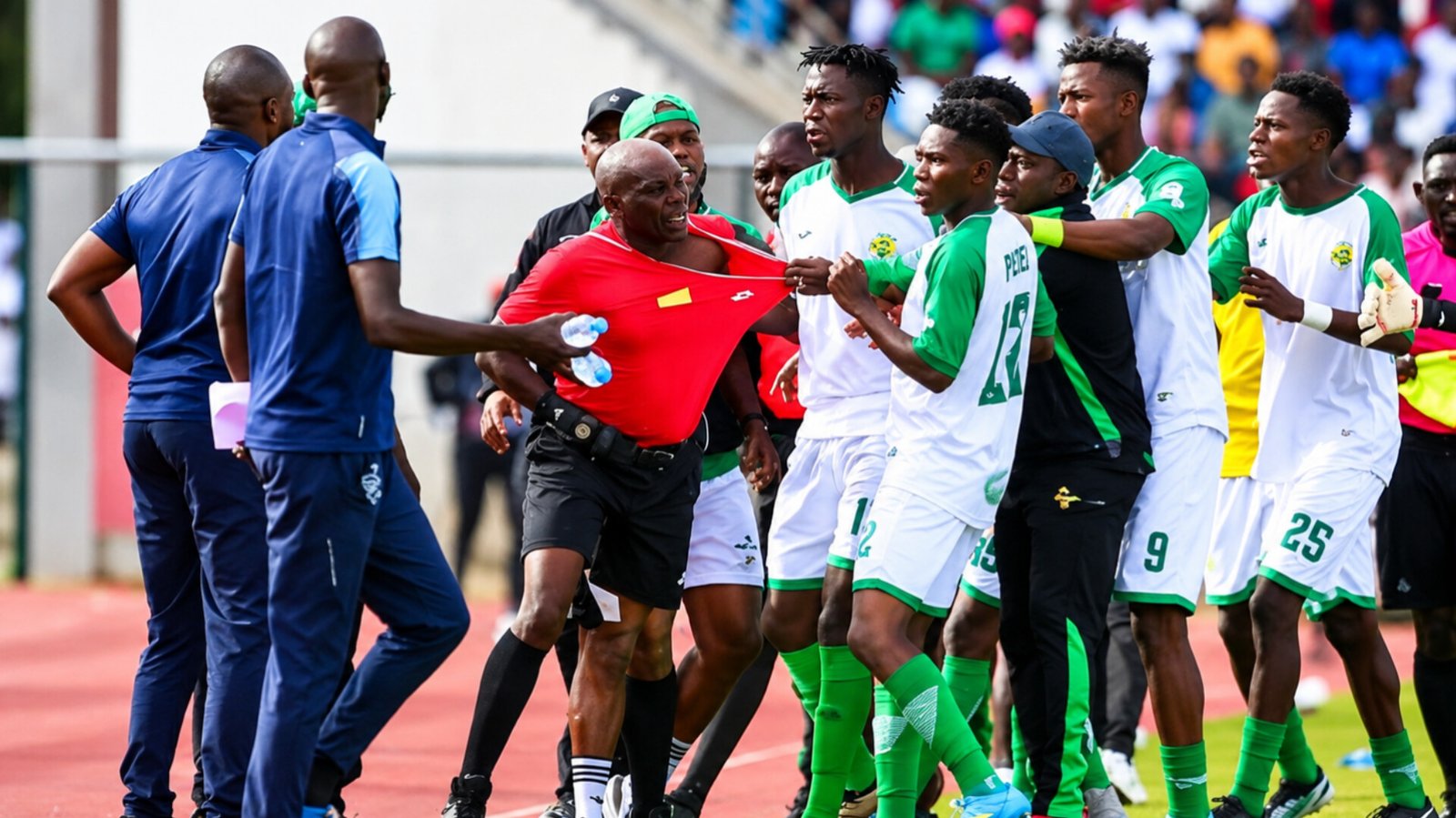
Kariobangi Sharks could face FKF sanctions, match forfeiture and individual disciplinary action after fans invaded the pitch and referee John Sulwe was attacked during the abandoned playoff.
What was supposed to settle one of Kenyan football’s biggest promotion and relegation battles ended in a pitch invasion, a confrontation involving referee John Sulwe and the abandonment of the match.
The incident happened in the 65th minute at Ulinzi Sports Complex after Sulwe awarded Mombasa United a penalty. Sharks players protested the decision before a section of supporters invaded the pitch and confronted the referee.
Security officers eventually escorted Sulwe away as the match was stopped.
Sharks were leading 2-1 on the night, but the aggregate score was 3-3, with Mombasa United having won the first leg 2-1.
That scoreline, however, does not automatically make Sharks the winners.
Sharks could face a major FKF punishment
The first question is what FKF will do with the abandoned match.
The federation is expected to examine the referee’s report, match commissioner’s report, security reports and video evidence before deciding what happens next.
FKF rules provide for serious consequences where a club is found responsible for violence or hooliganism that causes a match to be abandoned.
Depending on the findings and the regulations applied to the playoff, Sharks could face a forfeiture, elimination or other competition sanctions.
But FKF must first establish who was responsible for the abandonment and whether the conduct was attributable to the club under the applicable rules.
The referee’s treatment could make matters worse
FKF regulations also contain specific provisions dealing with assaults against match officials.
Sanctions can become more severe depending on the nature of the assault and whether the official suffered bodily harm.
Players, technical officials or other individuals found responsible could therefore face disciplinary action separately from whatever happens to the match itself.
However, there is an important distinction.
Reports about the incident are not completely consistent on whether Sharks players physically assaulted Sulwe. Some reports say the players protested and surrounded the referee before supporters invaded the pitch, while other reports allege that players also attacked him.
That is something FKF will have to establish through its investigation and the available evidence.
What about the supporters?
The consequences could go beyond football.
Kenya’s Sports Act contains offences relating to violence and hooliganism at sporting events, including conduct directed at referees and other match officials.
If individual supporters are identified and evidence shows that they assaulted, threatened, injured or intimidated Sulwe, they could face criminal proceedings in their own capacity.
That is different from a disciplinary punishment against Kariobangi Sharks.
The club does not automatically go to prison because a supporter commits a criminal offence. The individual alleged to have committed the offence would have to be dealt with through the criminal justice system.
Sharks were already fighting to stay in the Premier League
The incident comes at the worst possible time for Sharks.
The club had already been fighting to retain its Premier League status after finishing 16th last season.
A dispute over the rules governing relegation eventually led to the two clubs agreeing to settle the matter through a two-legged playoff.
Mombasa United won the first leg 2-1.
Sharks then turned the second leg around in Nairobi and were leading 2-1 when the match descended into chaos.
Now, instead of simply trying to complete the playoff, Sharks could face a fresh disciplinary battle.
Could Mombasa United automatically be declared winners?
Not necessarily.
The abandonment does not automatically mean Mombasa United win the match.
FKF will have to consider the circumstances surrounding the stoppage and determine the appropriate outcome under the applicable competition regulations.
Recent abandoned-match cases in Kenyan football have produced different outcomes depending on the circumstances.
That means Sharks cannot be declared eliminated simply because the referee was forced to abandon the match.
At the same time, the fact that the club was leading when the game stopped does not guarantee that Sharks will be awarded the result.
What happens next?
FKF will now have to establish exactly what happened on the pitch.
The referee’s report, match commissioner’s report, security reports and video footage are likely to be crucial.
The federation will then determine whether the match should be completed, whether one side should be awarded the result, or whether another outcome is required under the competition rules.
Separate disciplinary proceedings could also follow against players, officials, supporters or the club, depending on what the evidence shows.
For Sharks, the stakes could hardly be higher.
A match that was supposed to decide their Premier League future has now created another fight — and this time, the biggest question may not be who scored the most goals, but who FKF holds responsible for what happened.