

How Elon Musk’s Tesla Roadster Can Fly, Flip in Mid-Air and Drive Upside Down
A car that can drive upside down, launch into the air and perform a mid-air flip sounds like something from a movie. But Tesla has demonstrated these stunts with its redesigned Roadster, using technology developed with SpaceX.
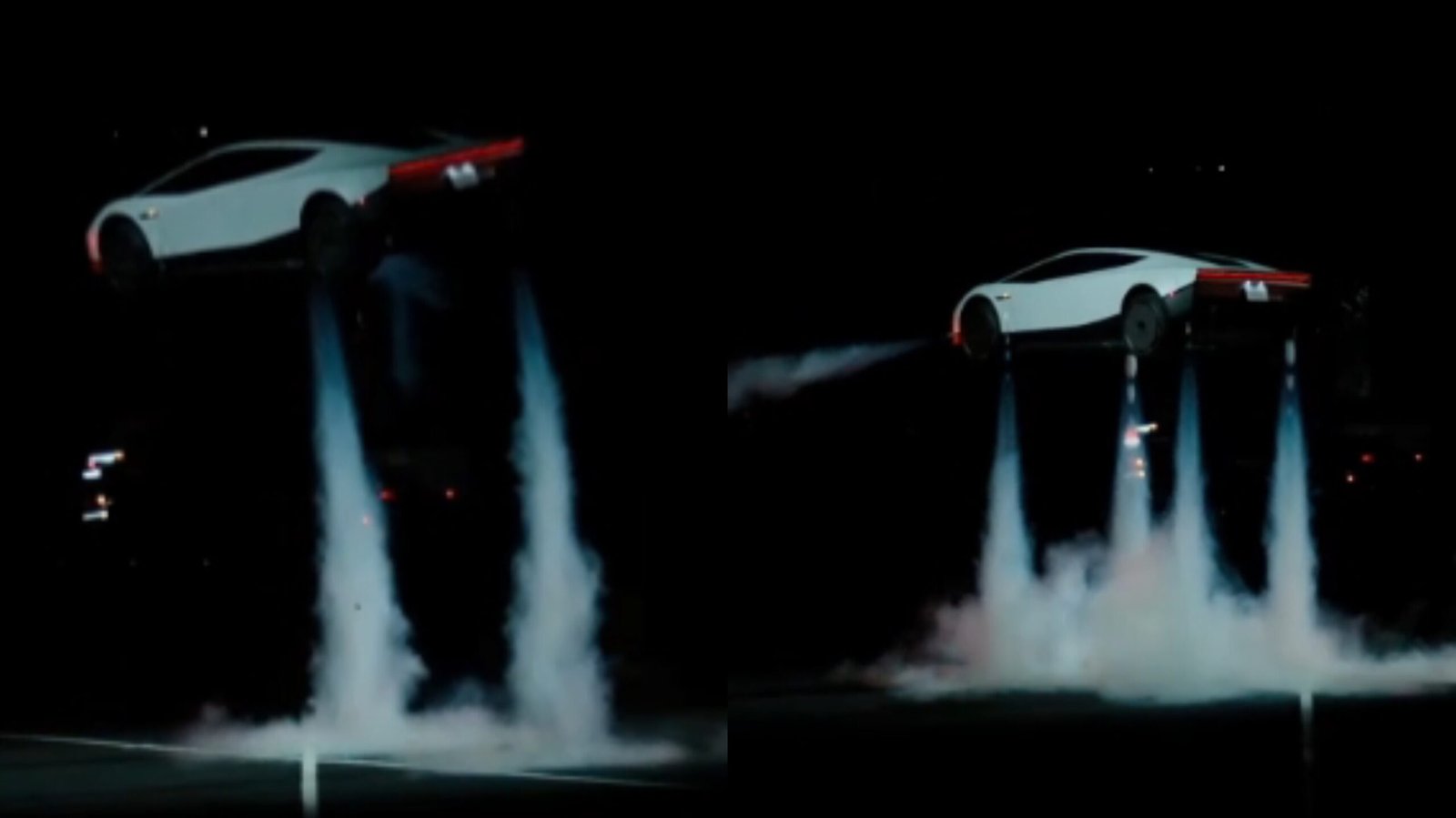
The secret lies in a system of compressed-gas thrusters that can push the car in different directions. Unlike an aircraft, the Roadster does not rely on wings or propellers to perform its brief aerial maneuvers.
How rocket thrusters lift the car
The Roadster’s rocket-assisted system uses highly pressurized gas stored in a reinforced tank inside the vehicle. When released through special nozzles, the gas shoots out at high speed, creating a force in the opposite direction.
That force is what allows the car to lift off the ground. Tesla’s Rocket version is designed to use thrusters positioned around the vehicle to generate upward movement and control its position in the air.
According to MotorTrend, the system uses cold-gas thrusters, which release pressurized gas without burning fuel to produce hot exhaust. The challenge is storing enough gas in a car while keeping the system compact and controlling the forces it produces.
How it flips in mid-air
The thrusters are not only intended to lift the Roadster. Their positioning also allows the system to control the car’s movement.
By directing thrust in different directions, the vehicle can generate the rotational force needed to perform a flip. Additional adjustments help control its position as it comes back down.
This is similar in principle to how spacecraft use small thrusters to change their orientation. The difference is that the Roadster must perform these maneuvers close to the ground, where controlling its movement and landing becomes critical.
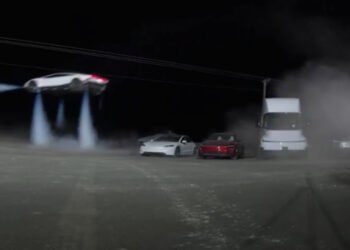
Tesla demonstrated the car flipping in the air and landing during its October 15 presentation in Texas. However, the demonstration does not establish how reliably the system would perform under everyday conditions.
How it drives upside down
The flying stunt was not the only unusual part of the demonstration. The Roadster also travelled upside down along a curved track.
For this, Tesla uses a different technology: a fan-powered suction system beneath the car.
The fans pull air from underneath the vehicle, creating lower pressure in that space. The higher air pressure outside then pushes the car towards the track, helping it remain attached even when inverted.
This is different from the rocket thrusters, which provide force for aerial movement. The suction system holds the car against a surface; the thrusters help it lift off and maneuver.
The system was demonstrated on a specially designed track, not an ordinary road or ceiling.
Is it a flying car for everyday use?
Not in the way most people imagine a flying car. Tesla has demonstrated brief lift-offs and aerial maneuvers, but it has not shown the Roadster flying over long distances like an aircraft.
The Rocket version is designed for more extreme capabilities and is listed by Tesla as not approved for public-road use. The company has targeted 2028 for production, meaning the final vehicle and its capabilities have yet to be established in a production model.
For now, the Roadster’s most striking achievement is bringing rocket-style control technology into a sports car. Whether it can deliver those stunts safely and consistently outside a controlled demonstration remains to be seen.