
Kenya’s nationwide nurses’ strike has entered its fifth week, with no agreement yet between the Kenya National Union of Nurses and Midwives (KNUNM) and the Council of Governors over the implementation of the 2017 Collective Bargaining Agreement (CBA).
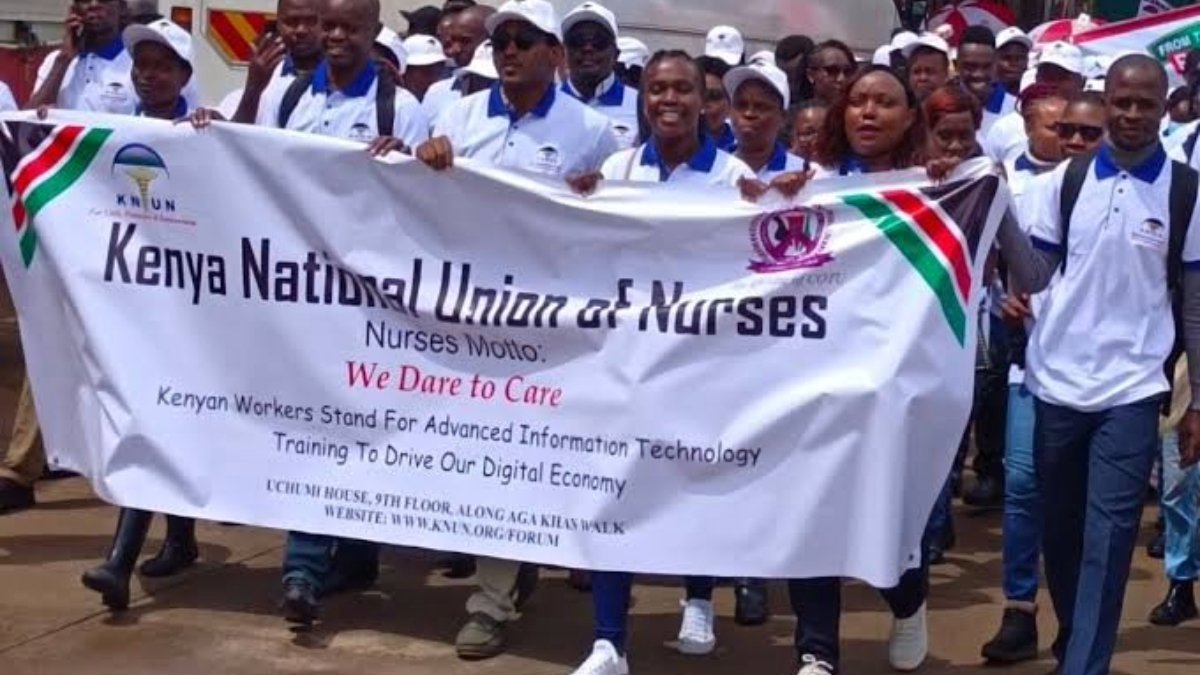
The standoff is now heading for a potentially dramatic showdown in Nairobi, where thousands of nurses and midwives from across the country are expected to take to the streets on Thursday, September 3, to pile pressure on the Salaries and Remuneration Commission (SRC) and the Council of Governors.
The union has made its position clear: the strike is not over.
KNUNM Secretary-General Seth Panyako said on Tuesday that negotiations have made progress on some of the nurses’ grievances, but the central issue — implementation of the 2017 CBA — remains unresolved.
“We do not have a deal yet,” Panyako said.
The union insists that it will not call off the nationwide industrial action until an agreement is reached and implemented.
9,400 nurses set for Nairobi showdown
The biggest escalation yet could come on Thursday.
KNUNM has notified the Inspector-General of Police of plans to mobilise approximately 9,400 nurses and midwives from all 47 counties for a major procession in Nairobi.
The union expects about 200 nurses from each county to participate.
The demonstration is scheduled to begin at Green Park at 9am, with protesters expected to move along Ngong Road towards the SRC before proceeding along Waiyaki Way to Delta House, the headquarters of the Council of Governors.
The health workers are expected to present their grievances to both institutions before returning to Green Park.
The message is simple: implement the deal
For KNUNM, the dispute is no longer simply about negotiations.
The union argues that the 2017 CBA was already agreed upon and should be implemented rather than subjected to what it describes as endless negotiations.
Nurses have rejected claims from governors that the agreement was signed under duress and have maintained that the CBA was negotiated and signed by the relevant government institutions.
The union has also pushed back against arguments that implementation would be financially unsustainable.
KNUNM leadership has previously estimated that approximately Sh5.9 billion would be required to fully implement the CBA.
What are the nurses demanding?
The nurses’ grievances extend beyond the CBA.
Among the issues raised during the dispute are:
- Implementation of the 2017 Collective Bargaining Agreement
- Better remuneration and allowances
- Career progression
- Permanent and pensionable employment for UHC nurses
- Implementation of agreed risk and uniform allowances
- Payment of statutory deductions
- Implementation of county-level return-to-work agreements
Some of these issues have seen movement during negotiations.
The union says progress has been made towards converting UHC nurses from contractual employment to permanent and pensionable terms.
There has also been agreement on establishing a joint committee to develop and implement career-progression guidelines for nurses across the 47 counties.
But those gains have not been enough to end the strike.
Governors push back
The Council of Governors has taken a harder line, urging striking nurses to return to work while negotiations continue.
Governors have also maintained that the ongoing strike is illegal and have directed county public service boards to take action against nurses who continue participating despite court orders requiring them to resume duty.
That position has further widened the gap between the two sides.
The nurses, on the other hand, argue that returning to work without a concrete agreement would simply allow the same unresolved problems to continue.
“No deal, no return”
That has effectively become the union’s position.
Panyako has repeatedly insisted that nurses will continue with the strike until an acceptable agreement is reached.
The union says it is willing to engage in dialogue, but wants the talks to produce a concrete solution rather than another round of promises.
The latest negotiations have therefore produced something of a paradox: there has been progress, but not enough progress to end the strike.
Patients bear the biggest burden
While the battle between nurses, governors and national institutions continues, patients remain caught in the middle.
The industrial action has disrupted services in public health facilities across the country, with some facilities struggling to cope with increased patient numbers.
At Kenyatta National Hospital, for example, maternity services have faced exceptionally high demand as patients from counties affected by the strike seek care at the national referral facility.
The longer the dispute lasts, the greater the pressure on hospitals, patients and families who depend on public healthcare.
September 3 could change everything
The planned Nairobi demonstration could become the most significant moment in the dispute so far.
With thousands of nurses expected to converge on the capital, the union is seeking to take its fight directly to the institutions it blames for the continued deadlock.
The route itself tells the story.
First stop: SRC, the institution at the centre of public-sector remuneration questions.
Second stop: Council of Governors, which plays a central role in county health employment and implementation of agreements affecting devolved health workers.
The planned march is therefore more than a protest.
It is a calculated attempt to turn a prolonged labour dispute into a national political and public pressure campaign.
The big question: When will the nurses return?
For now, there is no clear answer.
KNUNM says the strike will continue.
The Council of Governors wants nurses back at work while discussions continue.
Patients want hospitals fully operational.
And the national government is under growing pressure to help broker a solution to a dispute that has now stretched into its fifth week.
Unless the two sides bridge the gap over the 2017 CBA, Kenya could be heading for an even bigger health-sector confrontation.
For thousands of nurses, the message remains unchanged:
No implementation, no deal — and no return to work.